
Practical AI
Retire an obsolete procedure from the AI index, not just the folder
Deleting a source file does not necessarily remove its indexed copies. A support assistant needs a verifiable retirement process that follows obsolete content through retrieval and any answer cache.
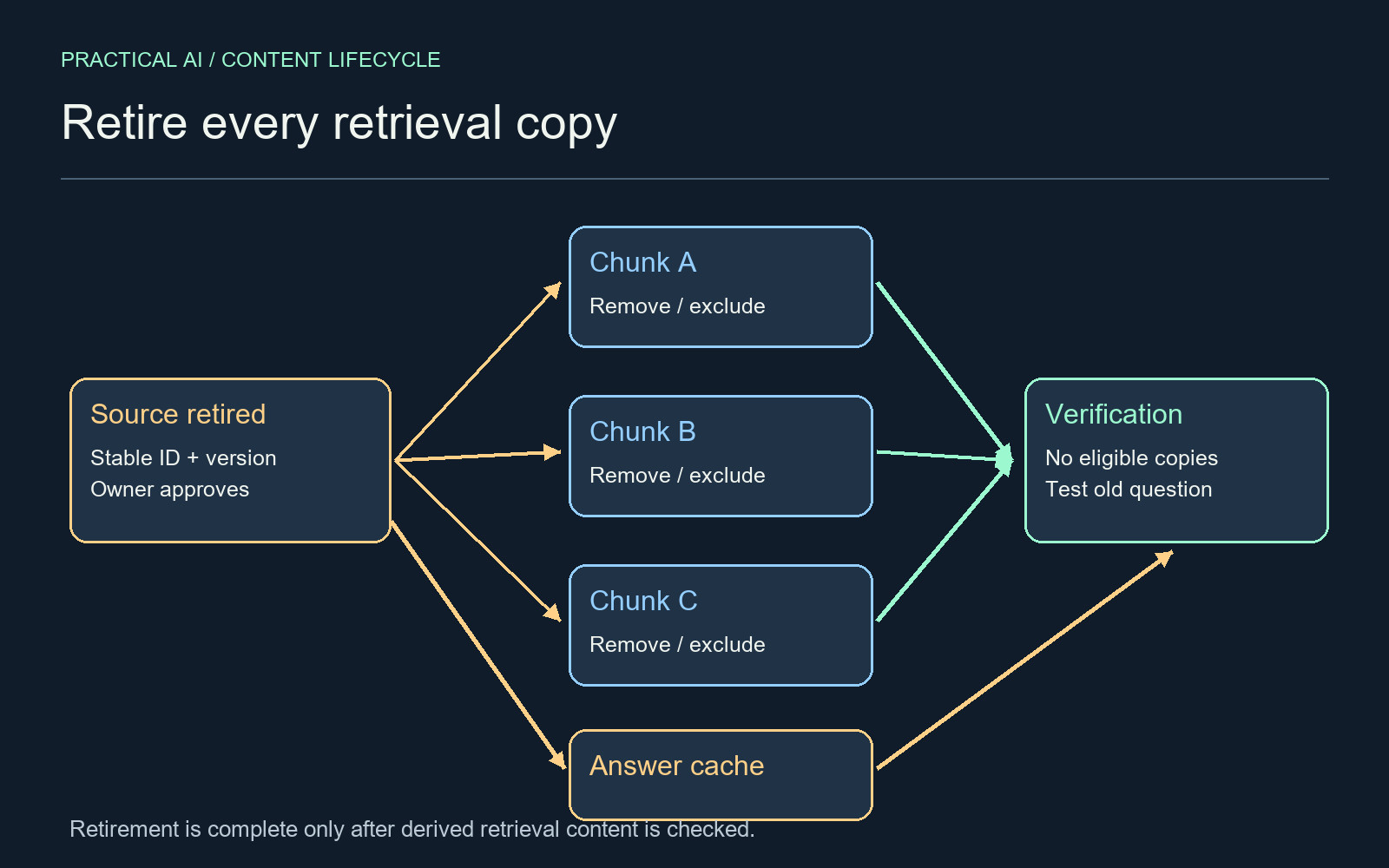
A citation can point to an obsolete rule
A support knowledge owner needs more than an assistant that cites its sources. The cited procedure must still be applicable to the question. The central proposal is to treat retirement as a lifecycle event that propagates through source records, derived retrieval content and any stored answer that depends on it.
Imagine an illustrative equipment distributor changing its return process. The old document is removed from the shared folder and a replacement is uploaded. An assistant still retrieves a chunk of the old procedure and gives a confident answer with a citation. The answer may faithfully summarize its retrieved text while giving staff an obsolete instruction.
Check deletion behavior explicitly
Microsoft’s Azure AI Search documentation explains that change detection and deletion detection are different concerns for storage indexers. It warns that source object deletion is not automatically tracked, and that a deletion strategy must be established from the first indexer run to avoid orphan documents.
The same documentation describes limitations for one-to-many indexing: the documented soft-delete approaches do not apply there, and deletion requests to the index are required. That detail matters when one file becomes multiple search records. Verify the behavior of your actual indexing pipeline rather than assuming that removing the parent file removes every derived chunk.
Maintain a source-to-derived-content map
A proposed content register can associate a stable source identifier with its version, owner, applicability dates, status and derived record identifiers. Keep replacement relationships explicit: superseded by a new version is different from withdrawn with no replacement. Do not use a filename alone as the lifecycle key if people routinely rename or copy documents.
At retrieval time, enforce the applicable status and date rules in the retrieval layer. Asking a model to ignore obsolete instructions after retrieving them is a weaker operational boundary than keeping ineligible material out of its evidence set. Historical questions may need old material, but that should be a deliberate mode with the applicable date made visible.
Retire, verify and then close the request
For each approved retirement, mark the source status, process the derived-record removal or exclusion, and inspect the resulting index state. If the system caches answers, invalidate or age out affected entries according to a documented dependency rule. If dependency tracking is absent, record that limitation and choose a conservative refresh procedure appropriate to the application.
Keep the retirement request open if an index job fails. A support owner should see which copies remain eligible and what recovery step is pending. This procedure is about preventing obsolete operational guidance; it is not a claim that every retained copy, backup or historical record has been permanently erased.
Test the question that used to retrieve it
Before retirement, record a controlled question that retrieves the old procedure. Afterward, inspect both retrieved records and the rendered answer. Test a paraphrase, an exact phrase from the old text and a question that should now have no supported answer. Where a replacement exists, verify its applicability rather than merely checking that its title appears.
Editorial hypothesis: a source-to-chunks retirement map will help knowledge owners include derived records in their acceptance checklist. The variable is the lifecycle diagram. Reader comprehension and obsolete-answer frequency remain unmeasured. This is a proposed method for review and testing, without a guarantee that an assistant will always answer correctly.