
Workflow improvement
Stop procurement intake from overloading the review queue
An automated intake form can make requests arrive faster without making review faster. Start with an explicit rule for when a request becomes active work, then show the capacity available to accept it.
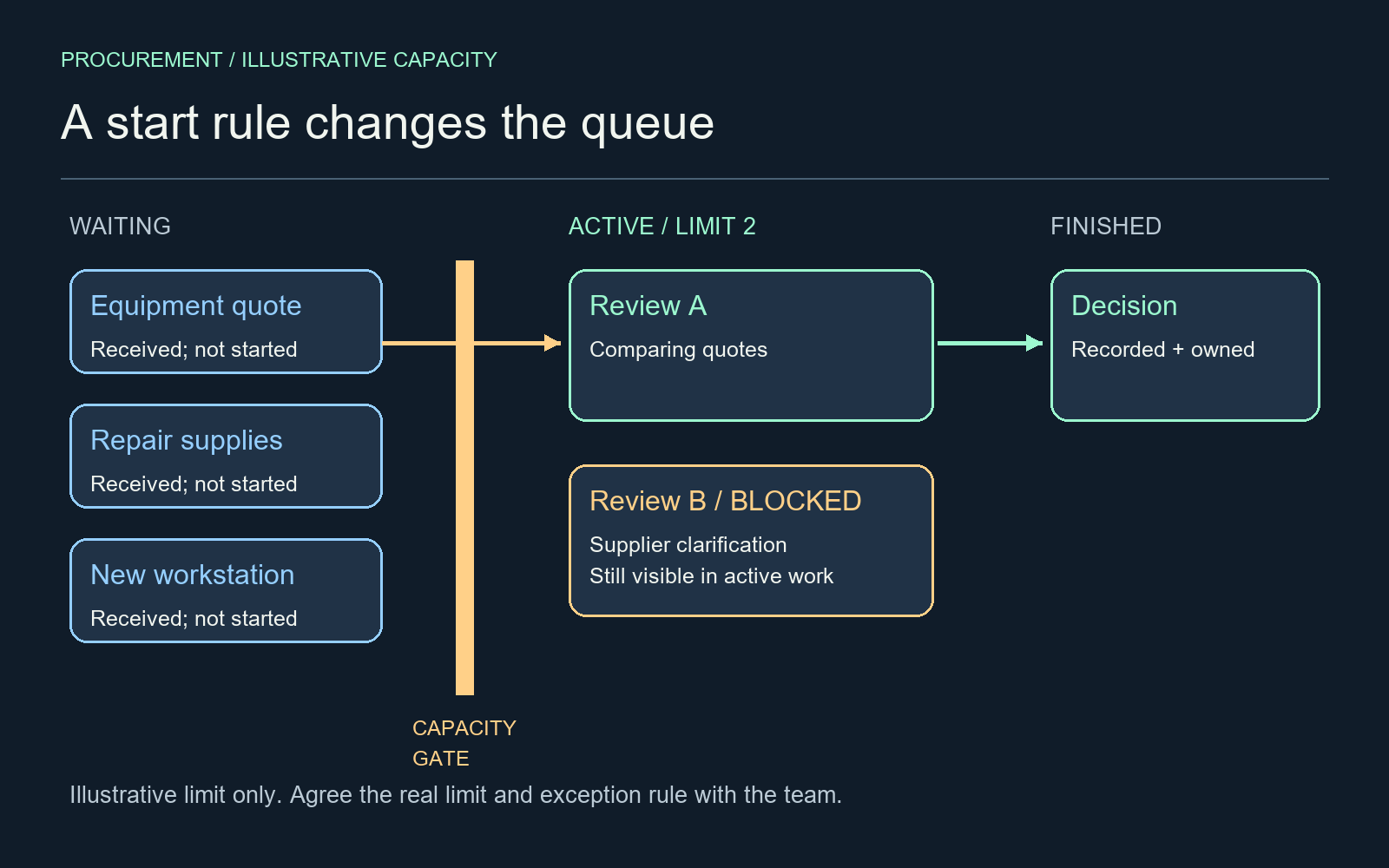
Separate received requests from accepted work
For a procurement coordinator, the useful question is not how many forms can be collected. It is how many quotation reviews the team can actively move toward a decision. A proposed improvement is to keep a visible waiting queue and admit new reviews only when the agreed capacity rule allows it. Receipt should acknowledge a request without silently promising that review has started.
Consider an illustrative facilities department buying replacement equipment. Requests arrive through email, a form and a shared spreadsheet. The coordinator creates a card for each request and assigns every card immediately. The board looks organized, yet reviewers still alternate between incomplete quotes, clarification calls and new requests. Adding another notification would make the queue more visible without changing this start rule.
Make the capacity rule observable
The May 2025 Kanban Guide calls for explicit control of work in progress from started to finished, with a signal that capacity exists before selecting more work. It also calls for explicit exceptions. Applying that principle here is a proposed operating method, not a procurement rule mandated by the guide.
Define one work item as one reviewable purchase request. Write down what starts review, what finishes it, and what information is required before entry. For an initial trial, the team might choose a small active-review limit based on its actual staffing. Any number in the trial is a local decision, not a universal benchmark. Show both the agreed limit and the current active count on the board.
Keep blocked reviews in view
A request waiting for a supplier answer still occupies attention and may prevent a decision. Give it a blocked reason, a next follow-up date and an owner. If blocked work is moved outside the active count, document why and keep a separate visible count; otherwise the team can appear to have spare capacity while carrying a hidden queue.
An urgent replacement should have an explicit exception path. Record who accepted it and which existing work is delayed. A blanket urgent label on every request defeats the rule. This is also where a human coordinator remains valuable: software can enforce an entry gate, but it cannot decide every tradeoff about service continuity.
Automate after the decision is clear
A useful first automation can check whether the request contains a comparable quote, delivery requirement and decision owner. It can return incomplete requests with a precise missing-information message. It can then acknowledge a complete request as waiting, with a visible queue position or status that does not imply a guaranteed completion date.
When capacity opens, the reviewer selects the next eligible item according to the agreed ordering rule. Log that transition. Do not have every form submission create an active task automatically. Test the behavior when two reviewers select work together and when an urgent request enters at the limit.
Run a small trial and inspect what changed
Compare age of open requests, completion time, blocked reasons and exceptions across a defined trial period. Account for request complexity and staffing changes before attributing any improvement to the new rule. If waiting time merely shifts upstream, inspect the whole request-to-decision journey. A board is useful only if it helps the team finish the right work.
Editorial hypothesis: showing the capacity gate separately from the waiting queue will help readers distinguish received work from accepted work. The variable is the gate diagram accompanying this explanation. Reader comprehension and operational outcomes have not been measured; this article reports a proposed method, not a client result.