
Workflow improvement
An empty intranet search result needs a diagnosis, not a bigger chatbot
An empty search result can have several causes. The answer may not exist, the user may not be allowed to see it, the page may not be indexed, or the search vocabulary may not match the document. A new AI interface does not remove these distinctions. Diagnose the failure before choosing a replacement.
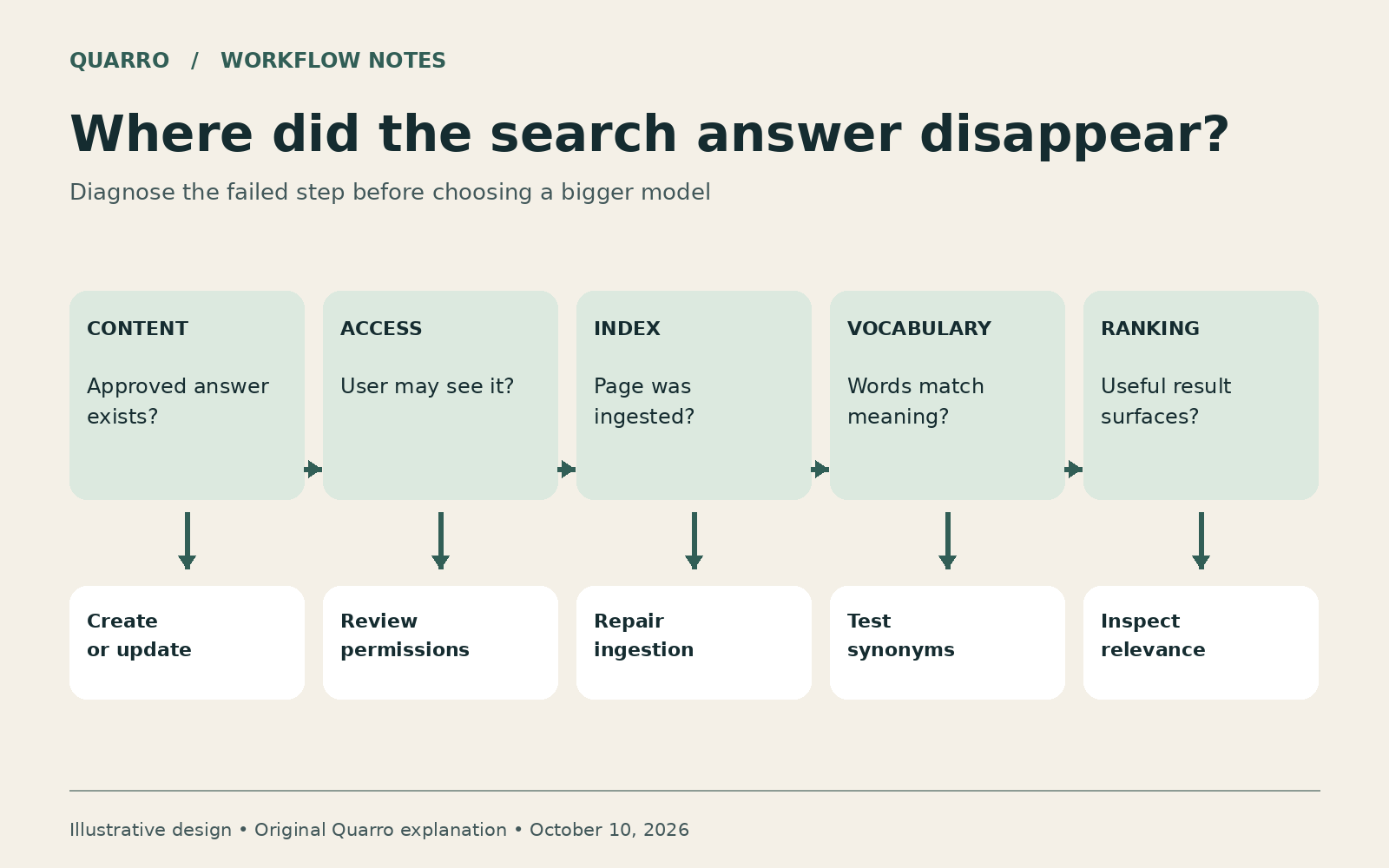
The answer: identify which step lost the answer
An empty search result can have several causes. The answer may not exist, the user may not be allowed to see it, the page may not be indexed, or the search vocabulary may not match the document. A new AI interface does not remove these distinctions. Diagnose the failure before choosing a replacement.
Consider an illustrative staff query for 'vehicle allowance.' The relevant policy is titled 'Mileage reimbursement.' Searching the exact title works, but the staff phrase returns nothing useful. That points toward a vocabulary or ranking problem. If neither query can find a policy that the user can open directly, ingestion and indexing need investigation first.
Move beyond the single demo query
Keyword search provides a straightforward way to match terms. Synonyms and improved ranking can address some vocabulary differences. Semantic retrieval may help with less literal phrasing. Each introduces its own trade-offs: broader matches can also introduce irrelevant results, and none makes missing or unauthorized content appropriate to disclose.
Elastic's documentation distinguishes equivalent synonyms from one-way mappings and describes testing the resulting search analysis. That is a useful mechanism for a controlled vocabulary fix. It is not evidence that adding every related word will improve search quality. 'Leave,' for example, can refer to time off or an instruction to depart, depending on context.
Keep a failure ledger
Collect a small set of permitted, sanitized questions that staff actually need answered. Avoid logging private details unnecessarily. For each, record the intended task, an approved reference answer or document, the relevant access role, observed results and the failure stage. Include queries that should not reveal an answer.
Use separate labels for no content, content outdated, access issue, indexing issue, vocabulary mismatch and poor ranking. A 'no content' label should create a content task. It should not trigger an engineer to relax search thresholds until something appears. Likewise, an access restriction needs review by the authorized owner, not a shortcut around permissions.
Test one fix against neighboring queries
For a suspected synonym gap, propose a narrow mapping and test it against the original question plus nearby questions where the expansion would be wrong. Record which approved result should appear and which should remain excluded. Preserve a comparison set that was not used to tune the change.
Measure useful task completion or judged relevance using documented reference answers. A reduction in zero-result queries alone is insufficient: returning unrelated pages can make that number look better while making the task harder. If an AI answer layer is later added, evaluate whether its statements are supported by the retrieved pages as a separate check.
A better first milestone
Start with a bounded collection and a few important staff tasks. Demonstrate that the system can retrieve an approved answer, explain a genuine absence and preserve access boundaries. Keep a route for reporting a bad result and assign responsibility for both content and search configuration.
The practical takeaway is to treat search as a chain of observable steps. Improve the step that fails, then test the full task again. That approach gives the team evidence for choosing ordinary search improvements, content work or a more advanced retrieval system without assuming the biggest model is the missing piece.