
Applied AI
AI search: preserve document permissions from source to answer
Plan permission-aware enterprise search with authenticated retrieval, synchronized access metadata, revocation handling and tests for derived answers.
Why this workflow needs an operating contract
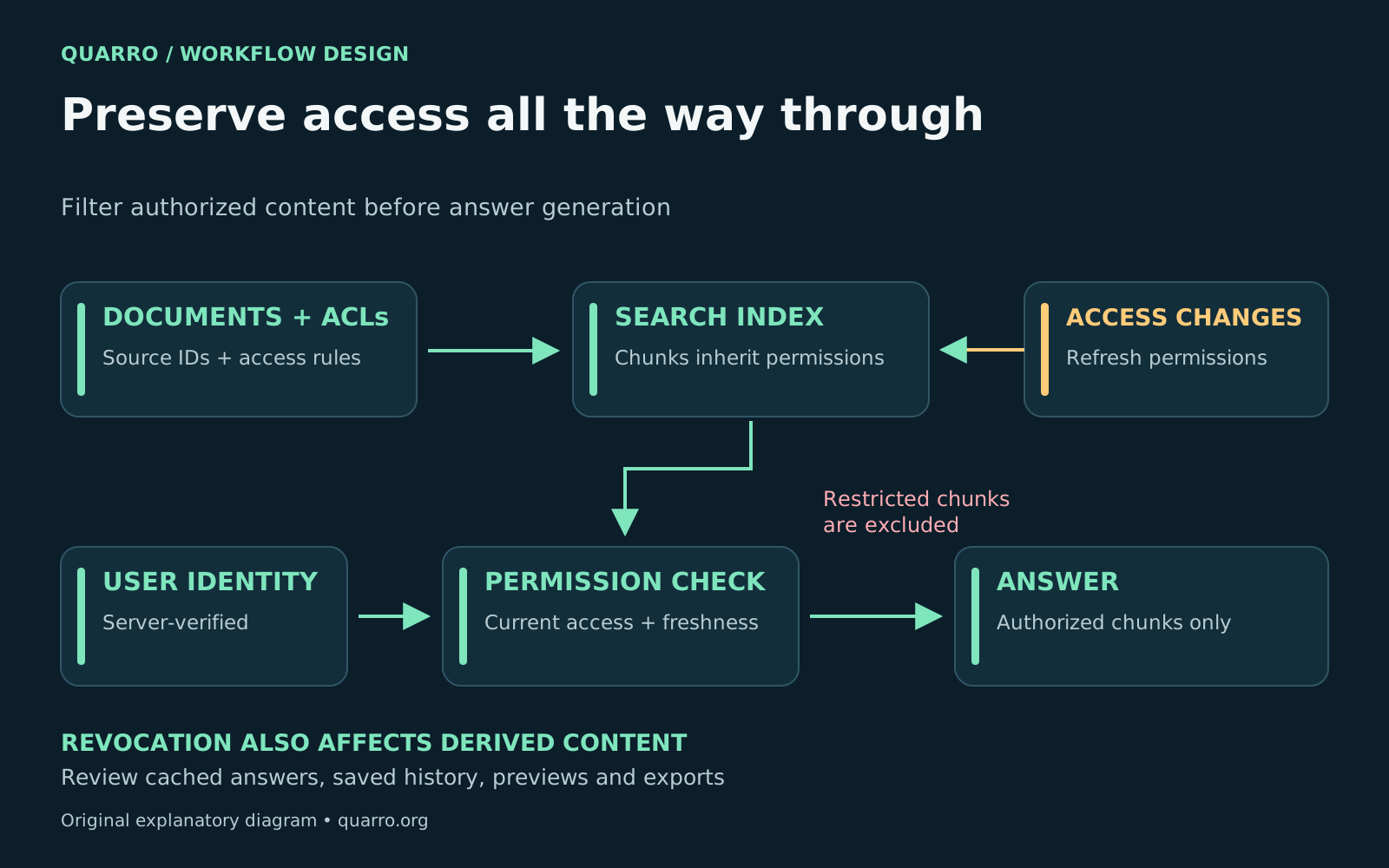
Permission-aware AI search should retrieve only content the current user is allowed to access, carry source permissions into derived chunks, and keep access changes synchronized. Apply these checks before restricted text reaches the answer generator. Include cached answers, conversation history and exports in the same access design. An internal knowledge assistant may index procedures, proposals and team documents in one place. Search quality can look excellent in an administrator’s demonstration while ordinary users receive information from another team’s restricted folder. The important acceptance test is what each identity can retrieve, including after their access changes.
Start with the source access model
List the repositories and permission rules that matter: direct grants, groups, inherited folder access, explicit denials and tenant boundaries. Identify who owns those rules and which system is authoritative. The connector’s ability to read a document for indexing does not establish that every user may read the indexed copy. For each indexed document, keep a stable source ID, tenant or workspace boundary, permission metadata, source version and synchronization timestamp. Derived chunks need a dependable link to that parent. If a document is re-chunked, make sure obsolete chunks are removed rather than left searchable under old permissions. Treat missing or unreadable permission metadata as an exception to investigate. Do not silently convert it into public access. <a href="https://cheatsheetseries.owasp.org/cheatsheets/Authorization_Cheat_Sheet.html">OWASP’s authorization recommendations</a> support deny-by-default behavior and checks on every request, which are useful starting principles for the retrieval path.
Build the permission filter from a trusted identity
Authenticate the user before search and resolve the permitted principals on the server. Do not accept an arbitrary group list supplied by a browser and treat it as proof of membership. Keep the search credentials and any broad indexing identity behind the application boundary. <a href="https://learn.microsoft.com/en-us/azure/search/search-security-trimming-for-azure-search">Azure AI Search’s security-filter pattern</a> makes an important distinction: principal IDs stored as strings can filter results, but string comparison does not authenticate a caller. The application is responsible for trustworthy identity resolution and consistent filtering. A field hidden from returned results is also not, by itself, a security boundary. Every route that retrieves content needs the same protection: keyword search, vector search, suggested questions, document previews, direct document lookup and exports. If a retrieval path cannot apply the required permissions reliably, keep that source out of the pilot until the gap is resolved.
Check the specific product capability you plan to deploy
<a href="https://learn.microsoft.com/en-us/azure/search/search-document-level-access-overview">Microsoft’s document-level access overview</a> distinguishes application-managed security filters from native identity-based approaches. Several native ACL, RBAC and sensitivity-label capabilities are marked preview in the documentation checked on October 6, 2026. Verify the exact source connector, API version, supported principal types and production suitability rather than assuming every integration preserves the same permissions. Choose the approach after testing it with the organization’s actual sharing model. A proof of concept with two direct user grants does not establish correct behavior for inherited permissions, nested groups or cross-workspace content.
Plan for access changes and revocations
Permission metadata can go stale independently of the document text. Microsoft notes that query-time checks against indexed permissions reflect source changes only after those permissions synchronize. A content-refresh schedule therefore needs an explicit permission-refresh design too. Set an operational target for how quickly a revocation should take effect. Decide what happens when the synchronizer is delayed or fails. For higher-risk sources, consider denying access when freshness cannot be established or checking the authoritative source again before returning content. Those choices involve availability and complexity tradeoffs that the owner should understand. Track permission synchronization failures separately from ordinary indexing failures. Reconcile removed documents and changed group relationships. A dashboard showing “all text indexed” can hide a broken revocation path.
Test derived content, not just source links
Filtering a citation after generation cannot remove information already incorporated into an answer. Give the model only authorized retrieved content, and restrict any tools it can call under the same user boundary. Treat retrieved document text as data rather than instructions that can override application controls. - Run the same question as an authorized user and a user without access - Repeat after removing a group grant and after moving a document - Try direct IDs, previews, downloads and alternative search routes - Check whether cached answers or saved conversations reveal newly restricted content - Confirm that logs contain enough diagnostic detail without unnecessary document text - Verify that a missing permission record fails safely An initial rollout can focus on a small, well-understood source set and expand after these tests pass. This keeps the access model explainable while the team improves relevance and usability. Related work includes <a href="https://quarro.org/blog/access-change-watch-offboarding-workflow/">offboarding and access-change tracking</a> and <a href="https://quarro.org/blog/ai-document-intake-review-queue/">human review for AI document intake</a>. Permission-aware retrieval belongs in a controlled <a href="https://quarro.org/">applied-AI implementation</a>, alongside integration ownership and support documentation.