
Implementation and support
Backup restore drills need business checks
A restore drill should establish that the business can use the recovered system, with acceptable data loss and within an agreed recovery time. A completed backup job is useful evidence, but it does not prove that the application, its attachments and its operational dependencies can be brought back together.
The practical issue
A restore drill should establish that the business can use the recovered system, with acceptable data loss and within an agreed recovery time. A completed backup job is useful evidence, but it does not prove that the application, its attachments and its operational dependencies can be brought back together.
Consider an illustrative service business with a custom job-tracking tool. The database may restore successfully while job photos remain unavailable, the application expects a newer database structure, or a background worker immediately starts sending old notifications. A realistic drill needs to catch those conditions before an outage makes them urgent.
Replace assumptions with a recoverable business task
The familiar approach is to check that backups run and occasionally open a restored database. That covers part of the problem. The remaining gap is whether a person can complete a representative task using the recovered environment.
AWS's reliability guidance on recovery testing calls for periodic recovery, validation of usable data, and comparison with recovery-time and recovery-point objectives. It specifically warns against restoring without querying or retrieving data. A business can apply this principle regardless of its hosting provider.
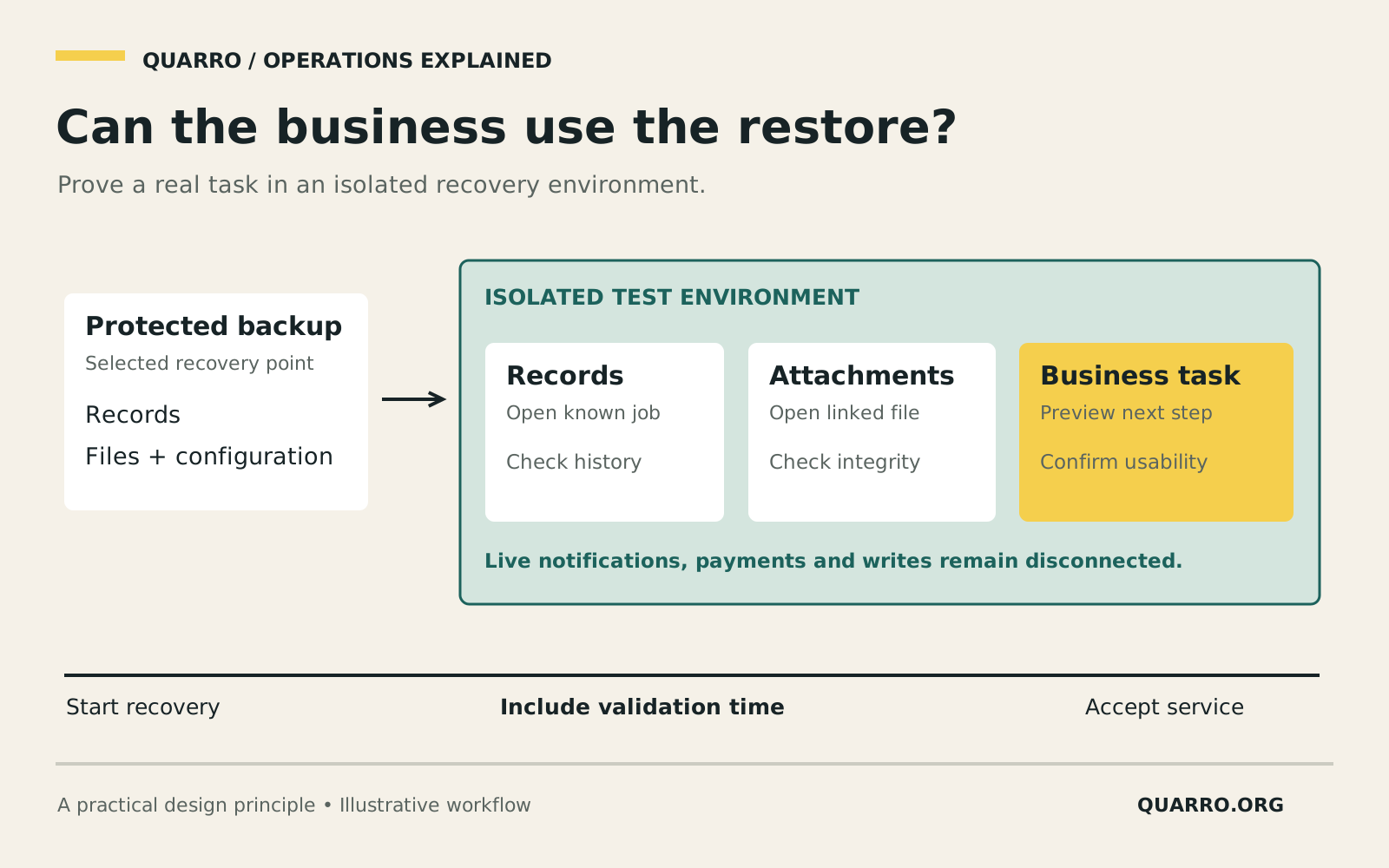
Choose a task that crosses the application's important dependencies. For the job-tracking example, open a known job, inspect an attachment, verify its status history and generate an internal preview of the next work step. Use a harmless preview or controlled test destination rather than triggering real customer communications.
Agree on the recovery objectives
The recovery-point objective describes the acceptable amount of data loss, typically expressed as time. The recovery-time objective describes the target time to restore the required service. Neither number should be invented by the software team without understanding the operational consequence.
Discuss what can be reconstructed and what cannot. Losing a short period of entered job notes may have a different consequence from losing the only copy of a signed document. Decide how the business would continue during recovery, who can invoke the plan and who can accept the recovered service. Record assumptions about staff availability and third-party access.
Inventory the dependencies that make records usable
List the database, file storage, application version, configuration, background jobs and external systems required for the chosen task. Keep credentials in approved secure storage; a runbook should point authorized operators to the access process rather than contain secrets.
Check whether the selected recovery points are compatible. A database record can reference a file that was created after the file-storage recovery point. A current application build can depend on a database change missing from an older backup. The drill should expose such mismatches and document a recovery sequence that addresses them.
Also identify data retained only by another service. Do not assume a vendor's availability or export capability is equivalent to a backup you can restore. Verify the actual recovery options and ownership for each dependency in scope.
Isolate the drill from live business effects
Restore into a controlled environment with restricted access. Prevent recovered workers, schedules and integrations from emailing customers, charging accounts, publishing updates or modifying live records. Preserve required protections for any personal or confidential data used in testing, and follow the organization's retention and deletion policy when the exercise ends.
Use explicit checkpoints: environment ready, data restored, dependencies connected, business checks passed and authorization to resume established. Measure elapsed time through validation rather than stopping the clock when the restore command returns. Keep a record of manual steps and missing access that slowed recovery.
Close the loop before the next incident
For each failed check, assign an owner and a corrective action. Then repeat the relevant part of the drill. A document that lists a broken dependency without establishing whether it was fixed gives the next operator little confidence.
The drill report should state its scope and limits. Recovering one application does not prove the entire company can recover, and a successful test under staffed conditions does not establish overnight coverage. Refresh the exercise when material dependencies change and at a cadence appropriate to the system's importance.
Quarro can help make recovery part of implementation support by connecting technical restoration to practical business checks. Start with one critical task and demonstrate that the team can perform it from the selected recovery point. For ongoing ownership, read [Who Owns the Tool After Launch?](/blog/custom-software-support-handoff/).