
Applied AI
AI classification needs a reject option before it routes work
A classifier that must always choose a label will eventually route work it does not understand. A production workflow needs a permitted reject state: uncertain, conflicting, out of scope or needs review. That state is not a model failure. It is an operational control.
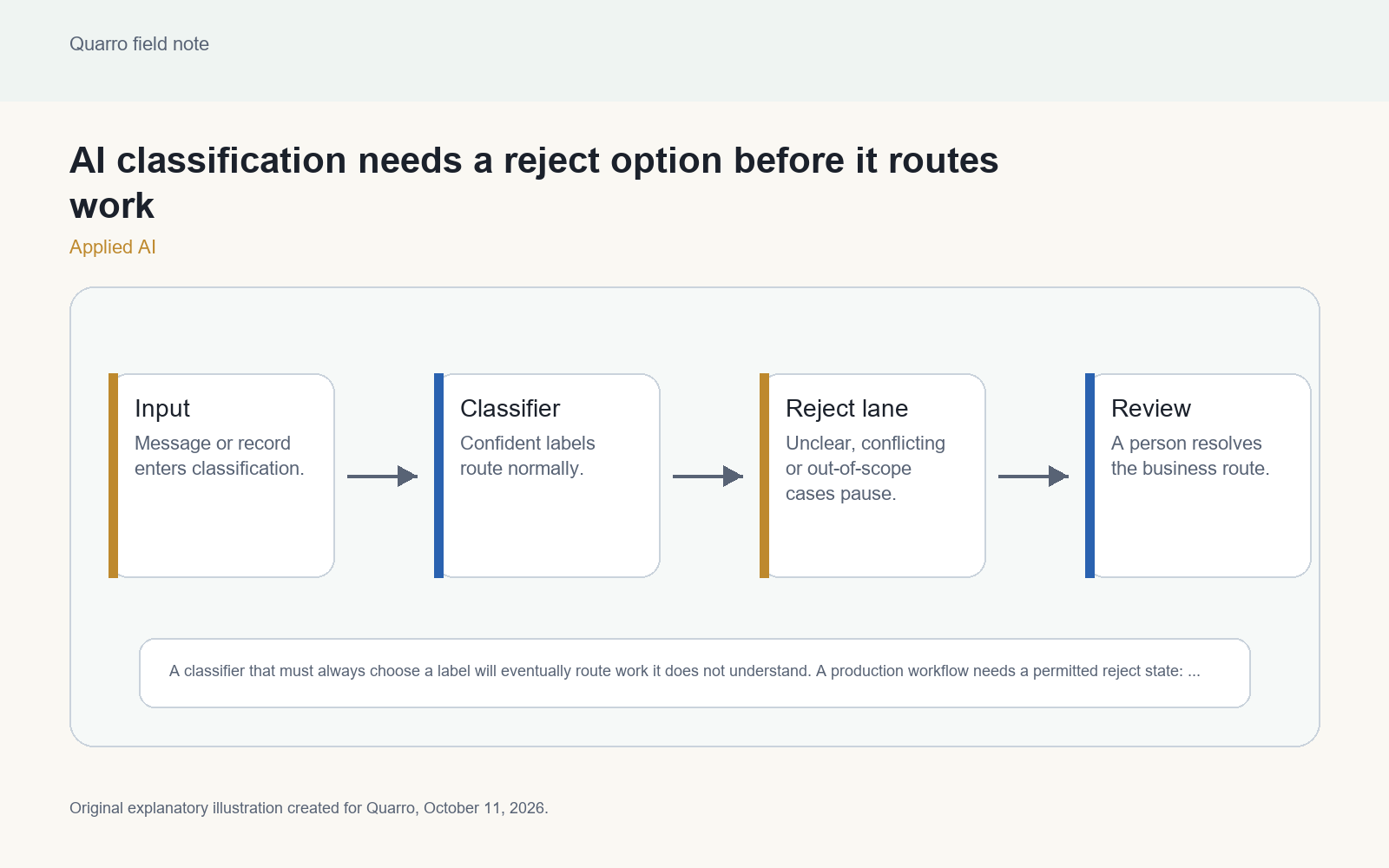
The answer: let the system say not enough evidence
A classifier that must always choose a label will eventually route work it does not understand. A production workflow needs a permitted reject state: uncertain, conflicting, out of scope or needs review. That state is not a model failure. It is an operational control.
For an illustrative support intake, an AI classifier might assign messages to Billing, Technical Support or Sales. A message that mentions invoice integration errors could fit more than one queue. Forcing a single label may save one click in the easy case and create a delay in the hard case. The workflow should be allowed to pause, ask for review or request missing information.
Define reject reasons, not one miscellaneous bucket
Useful reject states are specific. Low confidence means the model score did not meet the routing threshold. Conflicting evidence means multiple labels look plausible. Out of scope means the message belongs outside the supported process. Missing context means the classifier needs a field, attachment or account relationship before routing. Policy review means the label may affect a sensitive decision.
Each reject reason should have an owner and a next action. A general Other queue tends to become a backlog where product gaps, data quality issues and genuinely ambiguous work are mixed together. That makes the model look worse and the process harder to improve.
Risk framing belongs before launch
NIST describes the AI Risk Management Framework as voluntary guidance for incorporating trustworthiness considerations into AI design, development, use and evaluation. For classification workflows, that points to a practical question: what happens when the system is uncertain or wrong? The answer should be designed before automated routing changes real work.
Set thresholds using reviewed examples, not vibes. Keep a validation set that includes messy, ambiguous and out-of-scope cases. Measure how often the reject option is used, how reviewers resolve those cases and whether reject volume indicates a missing label, poor prompt, bad source data or a business rule that needs to be explicit.
Keep the review surface small and useful
A reviewer should see the proposed label, competing labels if relevant, the reason for rejection, the evidence used and the action that will happen after approval. Do not ask reviewers to debug the model. Ask them to make the business decision the model could not safely make.
Retain the original input, model version or prompt version, classification output, reviewer decision and final route. That history supports later evaluation and prevents a quiet change in model behavior from being mistaken for a staffing or customer behavior change.
Automate after the reject lane is healthy
Begin with assisted routing: the model proposes a label and the user can accept, change or reject it. Move only high-confidence, low-risk classes to automatic routing after the review history supports that choice. Keep sampling automatic decisions so the team can notice drift and edge cases that stop reaching reviewers.
The practical takeaway: a reject option is not indecision. It is how an AI workflow protects the business process while it learns where automation is reliable and where judgment still belongs.