
Practical AI
AI-Assisted Multilingual Support: Keep the Meaning, Check the Promise
A translated reply needs to preserve the customer’s question and the business’s actual answer. Give AI a bounded drafting role, with clear language review and a way to hold uncertain cases.
Start with a narrow service question
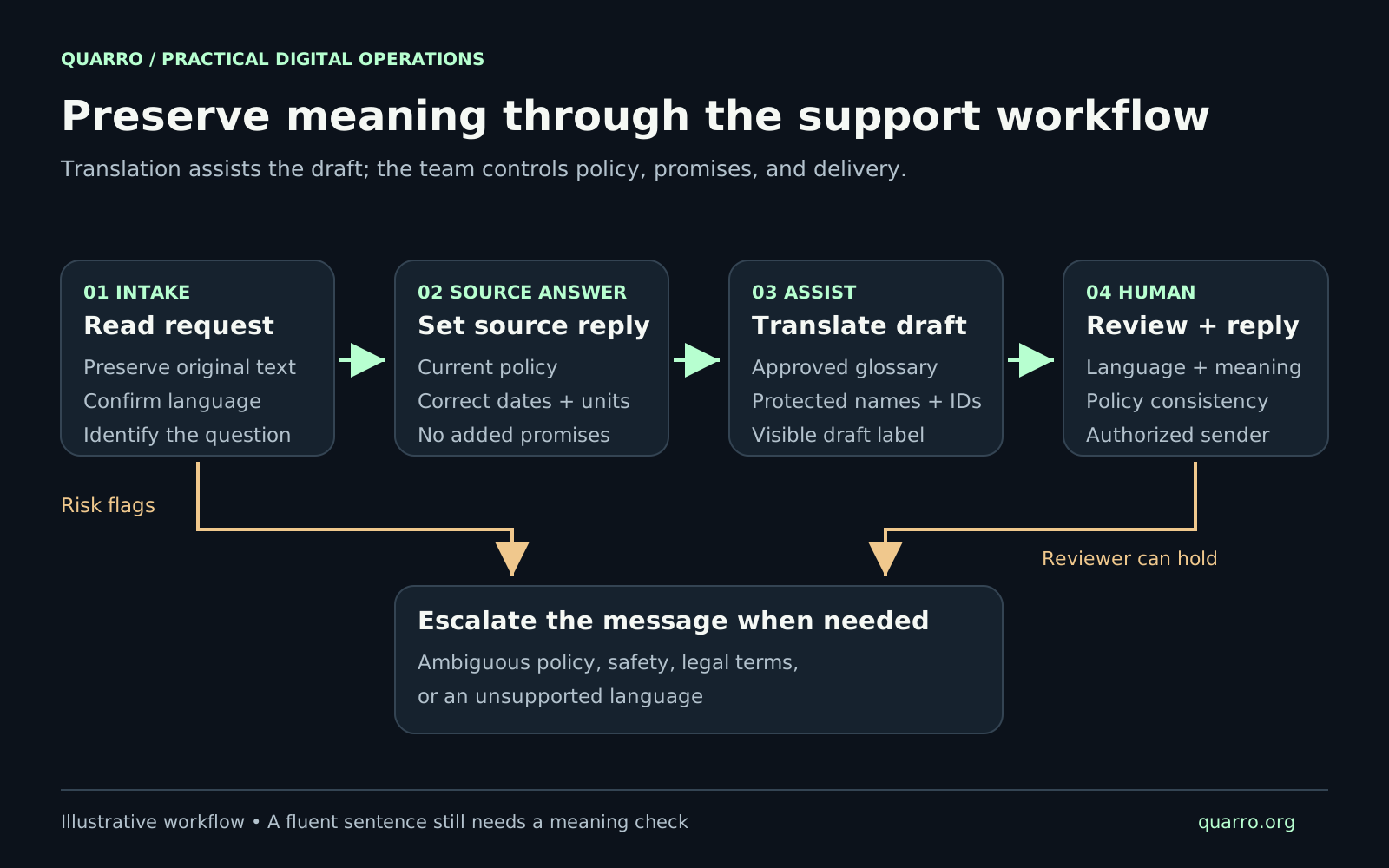
Imagine a fictional equipment supplier receiving a question in Spanish about a replacement part. Its support team can check the order and product documentation in English, but needs help preparing a reply in the customer’s language. This is a useful candidate for assisted drafting when the team can review the result. Define that task precisely before choosing a model. The assistant may help identify the question, prepare a translation, and flag uncertain terminology. The responsible employee still establishes the answer and decides whether it can be sent. Keep exceptions such as disputed charges, safety instructions, contractual terms, and promises outside an ordinary automated reply path. Choose language pairs the team can meaningfully review. If nobody available can assess a target language, arrange qualified assistance or an approved alternative. The ability to generate a sentence is insufficient evidence that the business can support that language.
Preserve the original message and establish the answer
Keep the customer’s original text attached to the ticket. A working translation should remain a separate, labeled view so a reviewer can revisit an ambiguous phrase. Record the requested language where known; a name, location, or short greeting is a weak basis for choosing it. Next, prepare the answer in a language the accountable support employee understands. Link the current policy or product information supporting it. State what is known, what needs checking, and what action is actually authorized. Resolve those questions before translating the reply. In the fictional part inquiry, a source answer might confirm compatibility while saying that availability is still being checked. The translated reply must preserve that uncertainty. It should not turn an open stock check into a delivery promise. If the source answer changes after review, regenerate or revise the translation from that updated version.
Control terms, identifiers, and formatting
Create a small approved glossary for product names, service terms, and phrases with a particular business meaning. Give each entry an owner and record which language pair it covers. Include context when the same word has different meanings across product lines. Google Cloud Translation’s glossary documentation describes dictionaries for domain-specific terminology, including product names and ambiguous terms. It also documents details such as case-sensitive matching and ignored stopwords. Check the behavior of the chosen service rather than assuming every glossary entry will always apply. Keep order numbers, part codes, links, and other exact identifiers separate from free-form rewriting where possible. Compare them against the approved source before sending. Inspect dates, decimal separators, units, and time zones explicitly. A correctly translated sentence can still direct the customer to the wrong day or part when formatting changes unnoticed.
Give the reviewer a meaningful comparison
Show the original request, approved source answer, translated draft, and relevant policy together. Make the draft’s status unmistakable. A reviewer should be able to edit it, request clarification, or hold it without losing the source material. Ask a qualified language reviewer to check meaning as well as tone. Did the reply answer the actual question? Did a condition disappear? Were negation, uncertainty, and responsibility preserved? Are any new commitments or instructions present? A second automated translation back into the source language can expose discrepancies, but cannot replace a qualified check of the target text. NIST’s Generative AI Profile identifies the risk of confidently presented false output and overreliance on automated systems. For this workflow, that supports a practical review rule: fluency is only one attribute to inspect. Review the business meaning and evidence even when the prose sounds polished.
Design the hold path before the send path
Decide what should stop a reply. Examples include an unsupported language, missing product context, uncertain customer intent, a conflict between policies, or a request needing specialist judgment. Each hold needs a reason and a named next owner. Avoid sending a vague answer merely to clear the queue. Keep drafting permissions separate from delivery permissions. A translation service generally needs the text required for its task; it does not need unrestricted access to the support archive. Review the provider’s data handling and the organization’s rules before including customer information. Remove unrelated personal details and keep diagnostic logs appropriately limited. The sending step should use the approved message version and the intended ticket recipient. If the customer adds a new question while a draft waits, flag the draft for review. An answer can become unsuitable without a single word of its translation changing.
Pilot for language quality and operational fit
Test a bounded set of routine cases with qualified reviewers. Include abbreviations, mixed-language text, ambiguous product names, a correction from the customer, and a request the workflow must hold. Use synthetic examples or properly authorized and protected records. Record the reason for each correction: misunderstood question, incorrect policy, changed commitment, terminology error, or formatting problem. Review these categories by language pair. Do not treat a good result in one language as proof of quality in another, or a small test set as a production accuracy guarantee. Compare review effort with the existing process, then decide whether the workflow is worth expanding. The useful outcome is a reply that preserves meaning and a support team that can explain how it was checked. Begin with one well-supported category, keep the glossary maintainable, and retain a clear route to a person when the answer needs judgment.