
Custom software
Address changes need effective dates before downstream systems update
An address change is not always effective immediately everywhere. Billing, shipping, tax, service territory and communications can each depend on different address meanings. A safe workflow records the new address, the effective date, the address purpose, the validation evidence and which downstream systems have accepted the change.
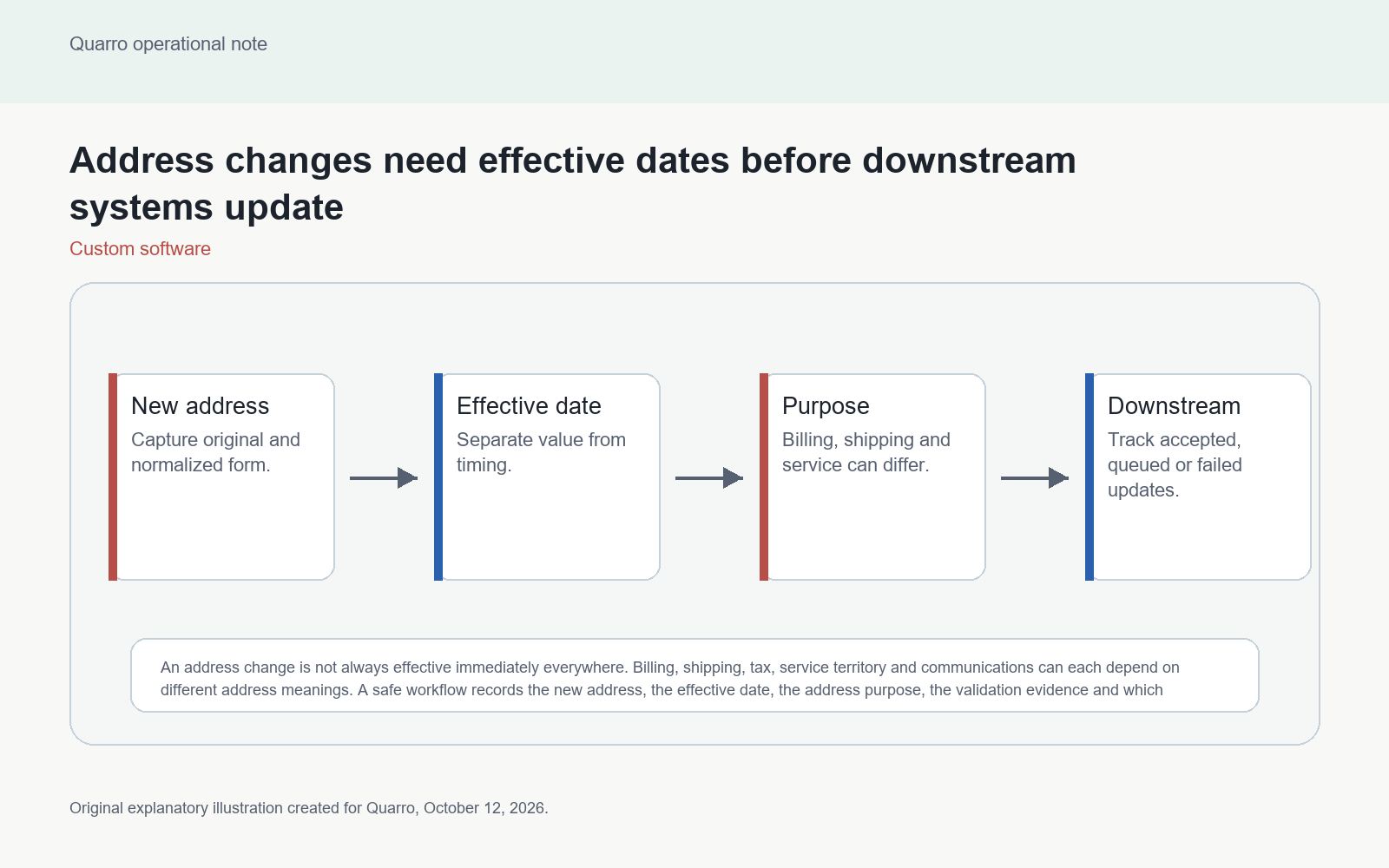
The answer: separate address value from address timing
An address change is not always effective immediately everywhere. Billing, shipping, tax, service territory and communications can each depend on different address meanings. A safe workflow records the new address, the effective date, the address purpose, the validation evidence and which downstream systems have accepted the change.
Imagine an illustrative service company. A customer moves offices next month but wants invoices sent to the current billing address until the move. Dispatch needs the new service address on the move date. Marketing should not send location-specific mail until the change is active. One overwrite field cannot express all of that safely.
Validate format without confusing it for truth
Address formatting standards help systems store and mail addresses consistently. USPS Publication 28 is a postal addressing standard and includes address information products and postal addressing standards. That kind of standard can support validation and normalization, but it does not decide which business address should be active for billing, shipping or service.
Keep the original user-entered address, the normalized form if used and the validation result. If a staff member overrides validation, capture the reason. A failed validation might mean a typo, a new development not yet recognized or an address that should be handled by a different process.
Use purpose-specific addresses
A customer may have legal, billing, shipping, service, tax and contact addresses. They can be identical, but they should not be forced to be identical by the data model. When one address changes, the workflow should ask which purpose changes and when. That prevents a shipping update from unintentionally changing legal correspondence or tax treatment.
Downstream systems should receive the address fields they need plus the effective date and purpose. If a downstream system cannot accept future-dated changes, the workflow should queue the update and show pending status rather than pretending the change is complete.
Keep the address history visible
Overwriting an address without history makes support harder. Staff may need to answer where a package was sent, why a tax jurisdiction changed or when service territory moved. Store prior address, new address, actor, timestamp, effective date, purpose, source and downstream delivery status.
History also helps integrations recover. If the warehouse system accepted the new shipping address but billing rejected the new billing address, support should see that split. The customer should not have to rediscover it by receiving the wrong document.
Test the calendar cases
Use authorized test records for immediate change, future-dated change, partial-purpose change, rejected validation, downstream failure and cancellation before the effective date. Confirm that each downstream system sees the right value at the right time and that users can tell what is pending.
The practical takeaway: an address is both data and timing. Effective dates and purpose-specific handling keep an ordinary customer update from becoming a silent integration problem.