
Data and reporting
When a payment provider appears to be your best referral source
Trace the checkout journey before changing referral rules. The domain a customer just returned from may not explain how they first found the store.
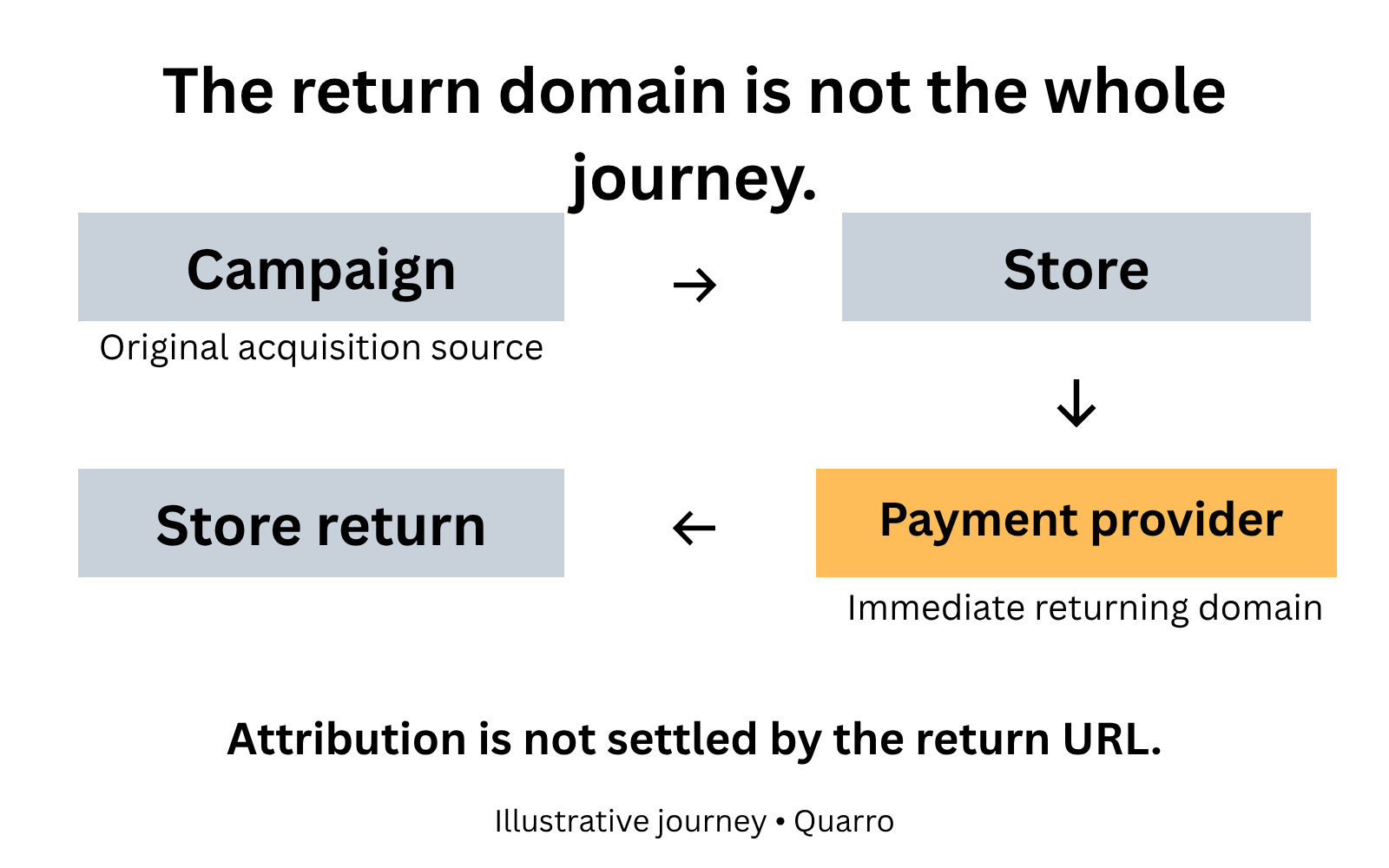
A familiar domain raises the wrong marketing question
A marketing report lists the payment provider among the store's referral sources. The team wonders whether that provider deserves acquisition credit, even though customers normally visit it only after choosing products.
In this illustrative journey, a person arrives from a campaign, browses the store, leaves to pay and returns to confirmation. The domain immediately before the return and the source that introduced the customer answer different questions.
Do not begin by deleting an inconvenient row. First establish which part of the journey the report is actually describing.
Follow one journey through the measurement system
Write down the domains involved in browsing, checkout and confirmation. Identify which belong to the business, which belong to a payment provider and where measurement is implemented. Use a permitted test journey rather than collecting unnecessary customer details.
Record the report being examined, its source dimension and reporting period. A source label alone is not enough to establish how the measurement system assigned it. Compare the journey with the configuration that was active when the events were collected.
This also gives the team a useful boundary: a payment service returning a customer is not automatically a new marketing partner, but neither is every external referral unwanted.
Apply the provider-specific distinction
Google Analytics documents unwanted referrals, including returns from third-party payment processors. Matching conditions cause events to carry an instruction to ignore the referrer as a traffic source. Google's guidance also distinguishes cross-domain measurement and warns that broadly ignoring referrers can discard useful source information.
These are Google Analytics behaviors, not a universal configuration recipe. An owned checkout domain and an external processor may call for different investigation. Confirm the measurement product, intended journey and current documentation before changing anything.
An exclusion is not evidence that missing history has been reconstructed. Preserve the date and reason for a configuration change so later report readers can distinguish a measurement change from a change in customer behavior.
Propose a narrow validation plan
For a store using the relevant Google Analytics setup, a proposed review could compare a campaign-to-checkout return with a visit from a genuine referring partner. The payment detour should be handled according to the agreed measurement design, while the useful partner referral remains available.
Have the measurement owner review the intended scope before applying rules. Record the exact domains and matching conditions. Avoid a broad pattern that also catches unrelated sites, and retain the previous configuration for an authorized rollback.
Check the result after the system's normal processing interval rather than demanding an immediate dashboard change. Keep old and new observations dated. A single test validates that journey under those conditions; it does not establish perfect attribution across browsers, consent choices and every purchase path.
Explain the reporting limitation to the business
When presenting the finding, separate observation from interpretation. “This journey returns from the processor” is an observation. “The processor acquired these customers” requires different evidence. Likewise, a lower referral count after a configuration change is not proof that marketing performance declined.
Keep a short measurement note beside the report: what changed, when it changed, which journeys were tested and which remain uncertain. Do not silently rewrite the narrative around historical charts.
Start with one checkout route and one suspicious source label. A documented explanation of that route is more useful than a long exclusion list assembled to make the report look tidy. If evidence is incomplete, keep the attribution question open rather than assigning confident credit to the last domain in the journey.