
Workflow improvement
A maintenance log should distinguish the symptom, the repair and the release
Make a maintenance record useful to the next shift by separating observations, working diagnoses, actions and verification of return to service.
The handoff problem
A maintenance ticket says “belt issue, adjusted, done.” The machine is running again. A week later, the same symptom appears, and the next shift cannot tell what was observed, what was guessed or what actually changed.
The problem is not necessarily a missing sensor or a missing AI model. The record has compressed several different kinds of information into one sentence. Before adding more automation, give each of those kinds of information a place to live.
This article proposes a small maintenance-record design. It is an illustrative software workflow, not a machine-repair procedure or evidence of measured downtime reduction.
Keep four statements separate
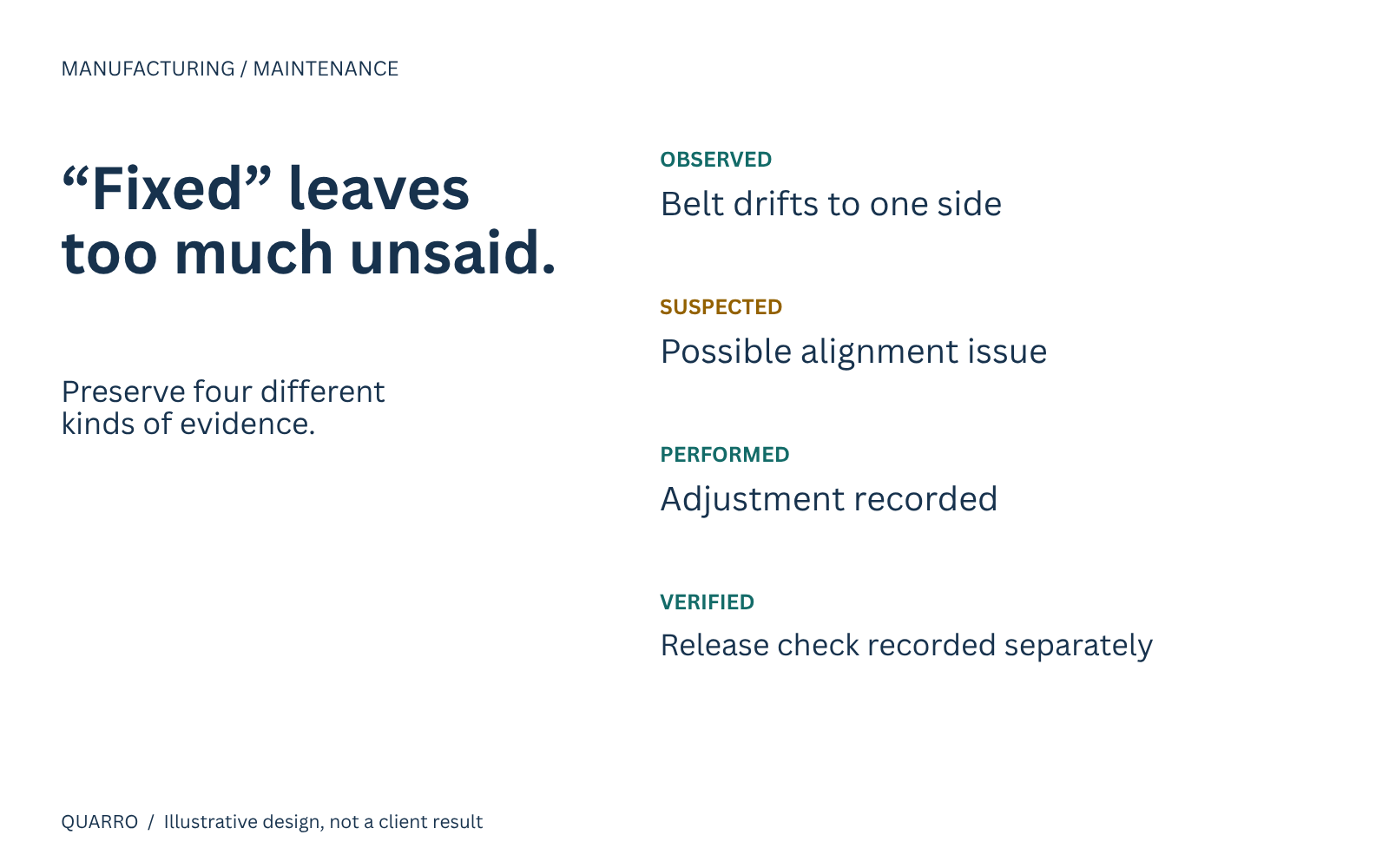
Consider an illustrative conveyor incident. An operator notices the belt drifting toward one side during a particular job. A technician suspects an alignment problem, makes an adjustment and checks the machine under the site's approved procedure.
Those statements belong in four distinct sections:
- Observed symptom: What was actually seen, when, on which asset and under what operating conditions?
- Working diagnosis: What might explain it? Who made that assessment, and is it still provisional?
- Action performed: What was changed or inspected? Which work-order or part reference explains the action?
- Verification and release: What check was completed, what happened, and who made the authorized return-to-service decision?
A suspected cause should not become a confirmed failure category simply because the ticket has reached its final status. Likewise, recording a repair does not by itself demonstrate that the original symptom disappeared.
Why free text alone reaches a limit
A notes field is useful for detail. It is less useful when every note mixes symptoms, causes and actions in a different order. Searching for “belt” may bring back a replacement, a cleaning task, a suspected problem and an unrelated inspection. Grouping those entries under a single failure count would answer an unclear question.
NIST's maintenance research overview describes work orders as human-generated records that capture equipment health, failures and repairs, alongside information generated by equipment and sensors. That supports treating the written record as a useful data source, rather than assuming only automated measurements matter. It does not prescribe the four-part form proposed here or establish its performance. NIST maintenance overview.
A practical improvement is to retain the narrative while adding a few structured fields. The purpose is not to force every incident into a perfect diagnosis. It is to preserve which parts of the story are known.
Design for the next person reading the record
For a first version, use a stable asset identifier, incident identifier and timestamps. Give the symptom and suspected cause separate labels. Allow “not established” for the cause. Attach the repair description to the person and time that recorded it, then keep verification separate from that description.
If a supervisor changes a diagnosis later, retain the earlier assessment with its status rather than silently rewriting it. A useful display can say “initial assessment” and “revised assessment,” with the supporting note beside each. That makes disagreement understandable without pretending the first explanation never existed.
Also distinguish a reopened incident from a new incident on the same asset. Otherwise, a report may count an unresolved problem as several successful repairs. Decide this convention with the maintenance team; software should not invent the operating definition.
Ask better reporting questions
With these distinctions, a manager can ask more precise questions:
1. Which assets have repeated observations of the same symptom?
2. Which closed records still lack a recorded verification outcome?
3. Which diagnoses were revised after inspection?
4. Which changes were followed by a recurrence under comparable conditions?
These are investigation prompts, not automatic conclusions about technician performance or root cause. A recurring symptom can have multiple causes. Different workloads, incomplete records and changes in operating conditions can make simple comparisons misleading.
Keep unknowns visible in the report. Excluding incomplete tickets from a chart may make the chart cleaner while hiding exactly where the process needs attention.
Start with one handoff, not a new maintenance platform
A bounded first project could redesign one work-order form and its shift-handoff view for one asset group. Review a small set of permitted historical records with the people who use them. Identify where the next reader has to guess. Then test whether the proposed fields let another team member reconstruct the incident without inventing missing details.
Do not ask software to decide that equipment is safe to operate. The site's qualified people, established procedures and applicable requirements still govern inspection and release. A form can record that decision; it cannot replace it.
The useful outcome is a more interpretable maintenance history: what happened, what someone thought, what they did and what was verified afterward. Establish that foundation before deciding whether prediction or AI-assisted analysis is the right next investment.