
Data and reporting
Duplicate customer records need merge evidence before a survivor is chosen
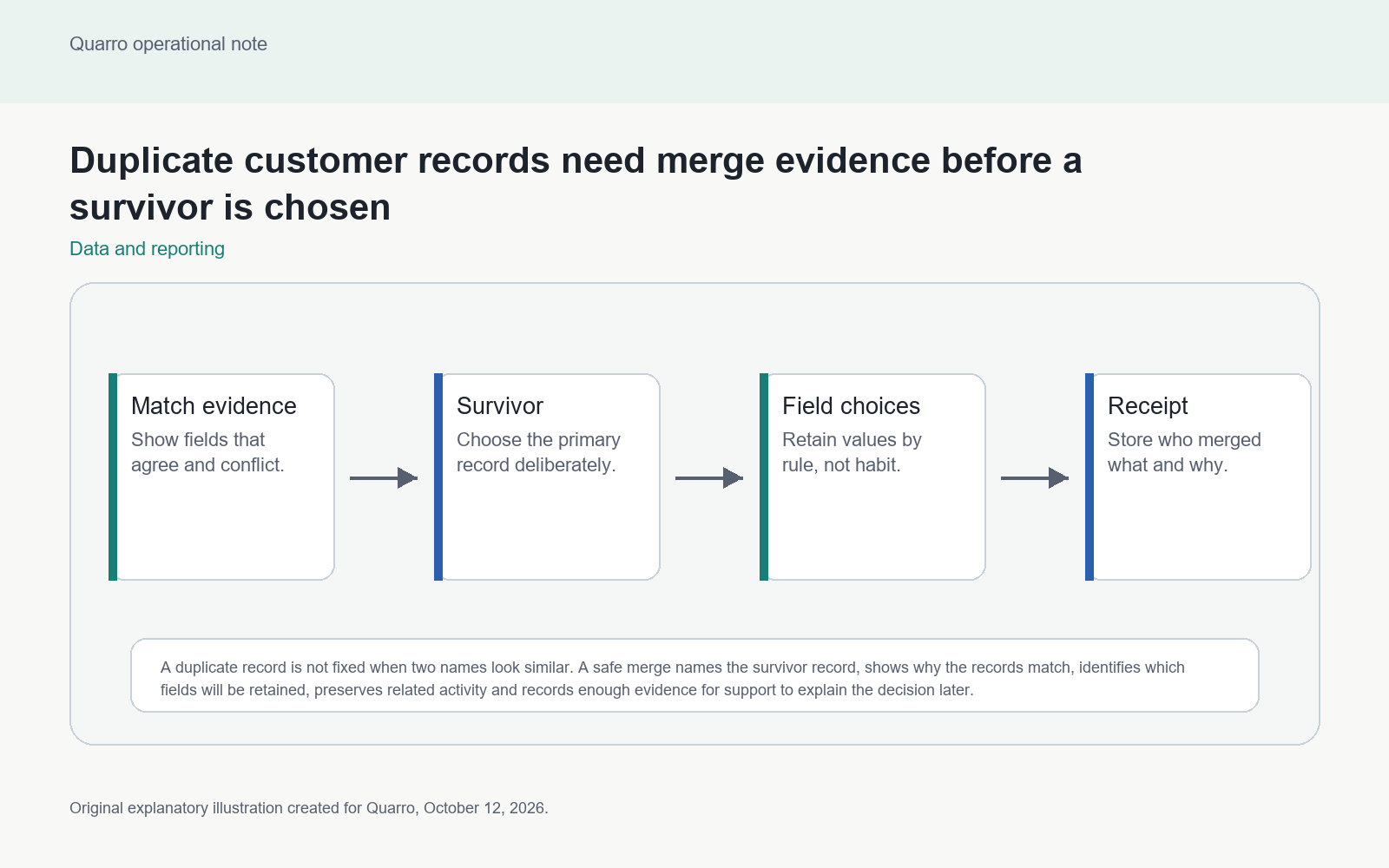
A duplicate record is not fixed when two names look similar. A safe merge names the survivor record, shows why the records match, identifies which fields will be retained, preserves related activity and records enough evidence for support to explain the decision later.
The answer: treat merge as a review decision
A duplicate record is not fixed when two names look similar. A safe merge names the survivor record, shows why the records match, identifies which fields will be retained, preserves related activity and records enough evidence for support to explain the decision later. The merge button should be the last step in a review, not the review itself.
Consider an illustrative CRM where two customer records share an email domain and company name but have different billing addresses. They might be duplicates, related branches or two companies with similar names. If the system collapses them automatically, staff may lose the context that would have prevented the wrong invoices, support tickets or sales history from being attached to the wrong account.
Show the evidence that created the match
A reviewer needs more than a score. Show the fields that matched, the fields that conflict, the age of each value and the source system that created or last changed it. Email, phone, tax identifier, external account key and postal address do not carry the same weight in every business. Some fields are strong identifiers; others are hints.
Microsoft Dataverse documentation describes duplicate detection for active records such as accounts and contacts, and its merge flow asks the user to choose a primary record and select fields from the secondary record. It also notes that child rows are merged and that some merge options are limited by table and field type. Those details are a reminder that merge design is partly data quality and partly workflow control.
Write survivorship rules before staff improvise
Survivorship rules say which value should win when records disagree. The newest value is not always best. Billing address might come from finance. Main contact might come from the account owner. Support preference might come from the customer portal. A rule can still allow exceptions, but the exception should require a reason.
Separate field survivorship from relationship handling. Notes, opportunities, tickets, invoices, files and subscriptions may need different merge behavior. Some should move to the survivor. Some should stay linked to the original record for audit. Some should require review before the merge completes.
Keep a merge receipt
Every completed merge should leave a receipt: survivor ID, merged record ID, reviewer, timestamp, fields retained, fields discarded, related objects moved, source evidence and reason. If the merge is later challenged, support can answer what happened without reconstructing it from memory.
Avoid deleting the secondary identity immediately if downstream systems still reference it. A redirect or alias table can help old links resolve to the survivor while integrations catch up. This is a proposed implementation pattern, not a claim that any particular CRM supports every mechanism.
Start with high-value duplicates
Begin with duplicates that already create operational pain: repeated invoices, split support history, incorrect account ownership or duplicate renewal reminders. Review a small batch manually and record why reviewers accepted or rejected each match. Use those decisions to refine matching and survivorship rules before scaling.
The practical takeaway: duplicate detection can find candidates, but merge evidence protects the business relationship. A trustworthy merge process makes the decision inspectable before and after records are combined.